Node.js and Modern Cryptography: Performance Meets Lockdown Security
A deep dive into the asynchronous V8 infrastructure, resource-efficient data streaming, and the mathematical implementation of end-to-end encryption.

The Node.js Event Loop: Non-Blocking Architecture
Node.js revolutionized the server landscape with its single-threaded event loop. Instead of spawning a new, memory-intensive thread for every incoming user (as traditional servers do), Node.js operates reliably and highly efficiently using non-blocking I/O operations.
This means that while the database processes a complex query in the background, the main thread remains free to simultaneously handle hundreds of other requests.
1. Live Streaming via HTTP Chunks (Chunked Transfer)
When a system outputs large volumes of data (such as a long chat feed on a message board), performance collapses if the server waits until all records have been collected in RAM. The solution is Chunked Transfer Encoding.
Instead of sending the response as a single, massive JSON packet, the data is flushed line-by-line (as a stream) to the Nginx proxy and the browser immediately as MariaDB releases each row.
Code Example: Records streaming directly from RAM
// The server sends data in chunks without closing the connection beforehand.
res.setHeader('Transfer-Encoding', 'chunked');
res.setHeader('Content-Type', 'text/plain; charset=utf-8');

const queryStream = pool.query('SELECT post, created FROM user_posts').stream();

queryStream.on('data', (row) => {
    // 🚀 INSTANT FLUSH: Every line sets off without hesitation.
    res.write(JSON.stringify(row) + '\n');

    // Forces any compression middleware to forward immediately.
    if (typeof res.flush === 'function') res.flush();
});

queryStream.on('end', () => res.end());
2. End-to-End Encryption (E2EE) & Hybrid Cryptography
The greatest Achilles' heel of a web infrastructure is storing master keys on the hard drive or in the .env
file (a single point of failure). If attackers gain access to the server, the entire database is compromised.
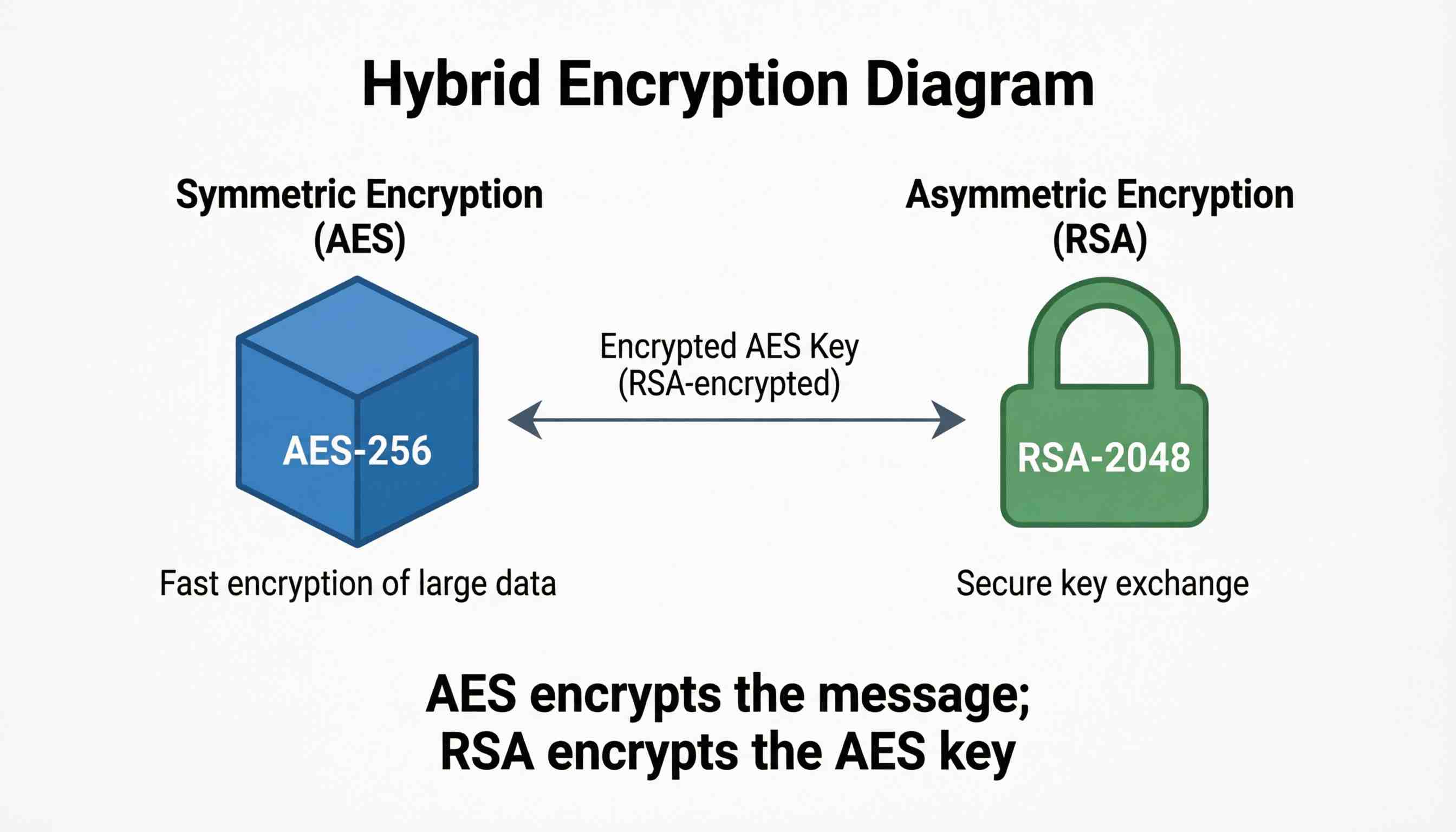
True end-to-end encryption (hybrid method) eliminates this risk. The message is sealed using a temporary, symmetric AES key. This key itself is then wrapped asymmetrically using the public keys of the authorized recipients.
Code Example: Asymmetric Decryption in the Crypto Lab
The user's private key is never permanently stored; instead, it exists only ephemerally in memory during verification.
Node.js uses the native crypto module to securely decrypt data in RAM:
import crypto from 'crypto';

export function decryptIncomingBackup(encryptedPayload, privateKeyFromAdmin) {
    // Converts the Base64 string from the database into a data buffer.
    const buffer = Buffer.from(encryptedPayload, 'base64');

    // 🔑 RSA-OAEP Decryption: Mathematical Lockdown
    const decryptedBuffer = crypto.privateDecrypt(
        {
            key: privateKeyFromAdmin,
            padding: crypto.constants.RSA_PKCS1_OAEP_PADDING,
            oaepHash: "sha256",
        },
        buffer
    );

    // Returns the raw plaintext without leaving traces on the hard drive.
    return decryptedBuffer.toString('utf8');
}
Infrastructure Security Note: Since JavaScript strings are immutable in memory, copies of strings remain in RAM until
garbage collection occurs. For maximum security in high-performance scenarios, the system processes these sensitive keys directly as
binary Buffer objects, which can be manually zeroed out after the operation.
Concluding thoughts
Only the combination of Node.js's asynchronous, non-blocking I/O model and a strict zero-knowledge crypto architecture creates an infrastructure that both withstands extreme loads and offers maximum protection against data leaks.