Glycerine and Isopropanol: The Humble Molecules That Moisturise Your Face and Clean Your Amiga
From 18th-century chemistry to vintage computer restoration, two quiet heroes share the workshop, the laboratory, and the bathroom cabinet between them - isopropanol on the circuit board, glycerine on the skin. Knowing which bottle to reach for is half the craft.
What Is Glycerine?
Glycerine - also known as glycerol or by its IUPAC name propane-1,2,3-triol - is a simple
yet remarkably versatile organic compound with the chemical formula
C3H8O3. At room temperature it presents as a
clear, colourless, viscous liquid with a distinctly sweet taste. It is hygroscopic (it pulls
moisture from the air), non-toxic and non-corrosive - and, crucially for the story below,
essentially non-volatile: it does not evaporate away, but stays behind as a faintly sticky
film.
Three hydroxyl (-OH) groups hang off its three-carbon backbone. This structure
gives glycerine its extraordinary ability to hydrate, lubricate, and act as a gentle
solvent in formulated products - talents that make it invaluable in cosmetics and food, and
exactly the wrong talents on a circuit board.
What Is Isopropanol?
Isopropanol - isopropyl alcohol, IPA, or propan-2-ol in IUPAC nomenclature - is glycerine's
far more volatile cousin, with the chemical formula C3H8O.
It is a clear, colourless liquid with a sharp, familiar spirit smell, and it evaporates
quickly and completely, leaving no residue behind. That single property makes it the default
solvent of the electronics workbench: it dissolves flux, oils, grease and grime, then simply
disappears. It is sold at around 70% strength for disinfecting, and at 90-99.9% for
electronics work, where extra water is the enemy.
A Short History
Glycerine first entered the scientific record in 1779, when the Swedish-German chemist Carl Wilhelm Scheele isolated it by heating olive oil with lead oxide. He called it the “sweet principle of fat.” For decades it remained little more than a laboratory curiosity.
The compound's industrial destiny changed in 1847, when Italian chemist Ascanio Sobrero synthesised nitroglycerine, and later when Alfred Nobel tamed that volatile liquid into dynamite. Glycerine suddenly became a strategic material, produced in enormous quantities as a by-product of soap-making and fat-splitting processes.
Throughout the 20th century its uses expanded rapidly: food additive, pharmaceutical humectant, antifreeze component, cosmetic base, and industrial lubricant. Today, a large share of global glycerine supply arrives as a by-product of biodiesel production, keeping the molecule cheap, abundant, and widely available.
Isopropanol's story is shorter and more industrial. It was first synthesised in 1853 by the English chemist Alexander William Williamson, but it made history in 1920, when Standard Oil of New Jersey began producing it from refinery propylene at its Bayway plant - widely regarded as the very first petrochemical product. Today it is one of the most common solvents and disinfectants on Earth, and the small clear bottle in every electronics repair kit.
General Use Cases
Both molecules have broad résumés - but very different ones:
- Food industry (glycerine): humectant, sweetener, and texture agent in baked goods, confectionery, and liqueurs.
- Pharmaceuticals (glycerine): carrier in cough syrups, suppositories, and topical ointments.
- Cosmetics and personal care (glycerine): backbone of many moisturisers, soaps, and shampoos.
- Crafts and conservation (glycerine): humectant in leather conditioning, leaf and floral preservation, and theatrical fog fluids.
- Electronics and repair (isopropanol): circuit-board and flux cleaning, contact cleaning, and thermal-paste removal.
- Disinfection (isopropanol): the active ingredient in many hand sanitisers and surface wipes at around 70% strength.
What you will not find on any credible list is glycerine as a circuit-board cleaner - a mix-up this article exists to correct.
The Retro-Computer Workbench: Isopropanol's Territory
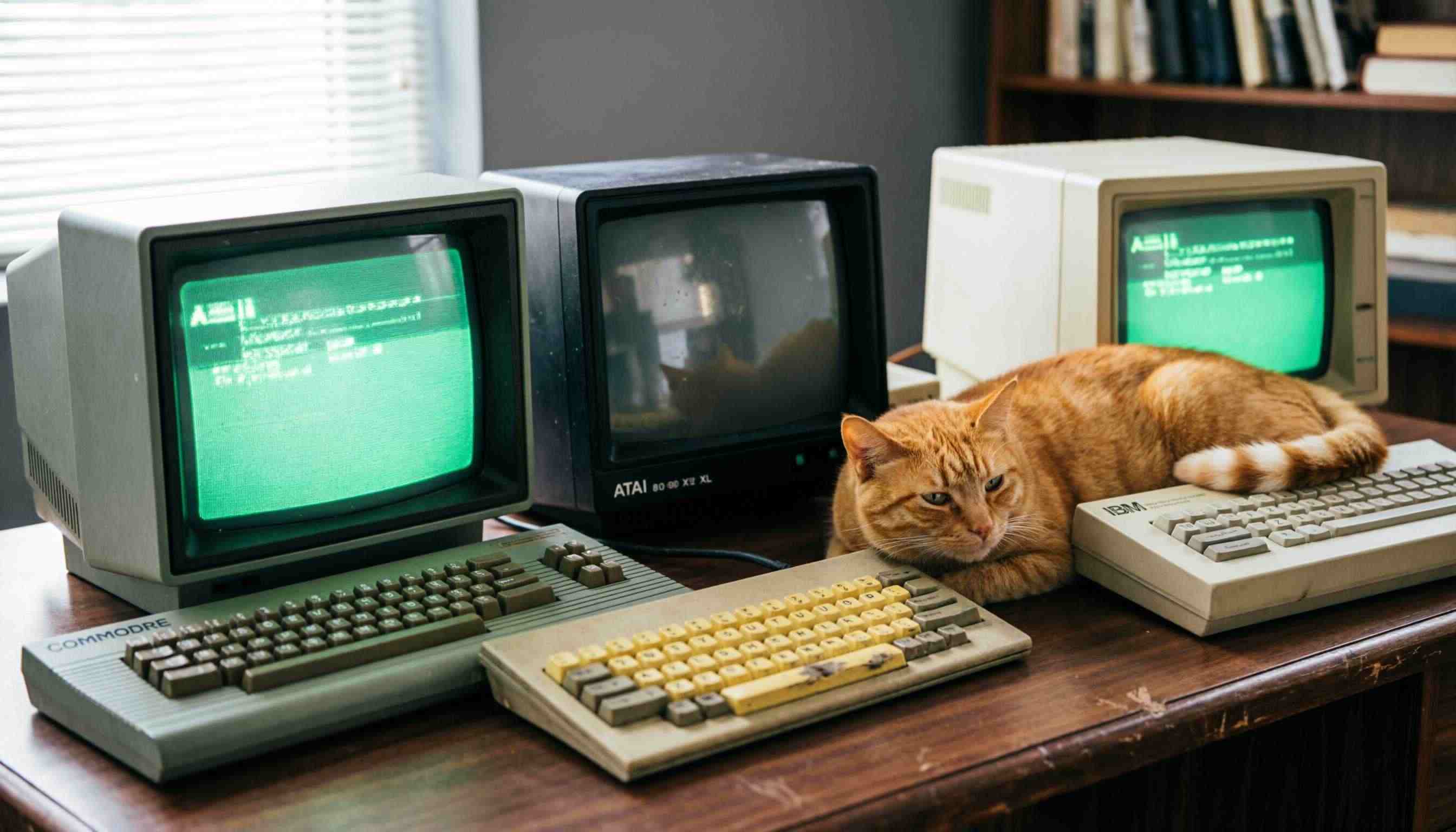
If you frequent forums dedicated to vintage home computing - threads about rescuing a barn-find Commodore 64, restoring an Amiga 500 pulled from a skip, or coaxing life back into an old console - you will sooner or later encounter someone recommending a small bottle of clear liquid. That bottle is isopropanol, not glycerine. Where glycerine does appear in such threads, it is almost always a mix-up of names - and on a PCB it is exactly the wrong chemistry.
Why Isopropanol Suits Old Electronics
Components manufactured in the 1980s and early 1990s age in ways modern parts do not. Solder joints grow brittle. Electrolytic capacitors weep. Plastic keycaps turn chalky. Rubber drive belts petrify. Flux residues and decades of nicotine, kitchen grease, and dust form a sticky film over PCB traces. A suitable cleaning agent should be:
- Residue-free, evaporating completely so nothing sticky or conductive is left behind.
- An effective solvent, able to dissolve old flux, grease, and nicotine film.
- Board-safe, harmless to solder mask, copper tracks, and silkscreen labels when used gently.
- Fast-drying, so the board can be safely powered again after a short wait.
High-purity isopropanol fits these requirements remarkably well. Glycerine fits none of them.
Circuit-Board Cleaning
One of the most common retro-computing uses is circuit-board cleaning. A typical session might look like this:
- The board is removed from its case - perhaps the motherboard of a Commodore 64 or the mainboard of an Amiga 500 - and photographed for reference.
- Loose dust is removed with compressed air.
- A soft brush or lint-free swab is dampened with 90% or stronger isopropanol (99% is ideal) and worked gently across the board.
- The isopropanol dissolves grime, old flux residue, and sticky surface contamination without attacking the solder mask or component markings.
- A clean swab, lightly dampened with fresh isopropanol, lifts the dissolved residue away.
- The board is left to dry fully - with IPA this takes only minutes - before power is applied.
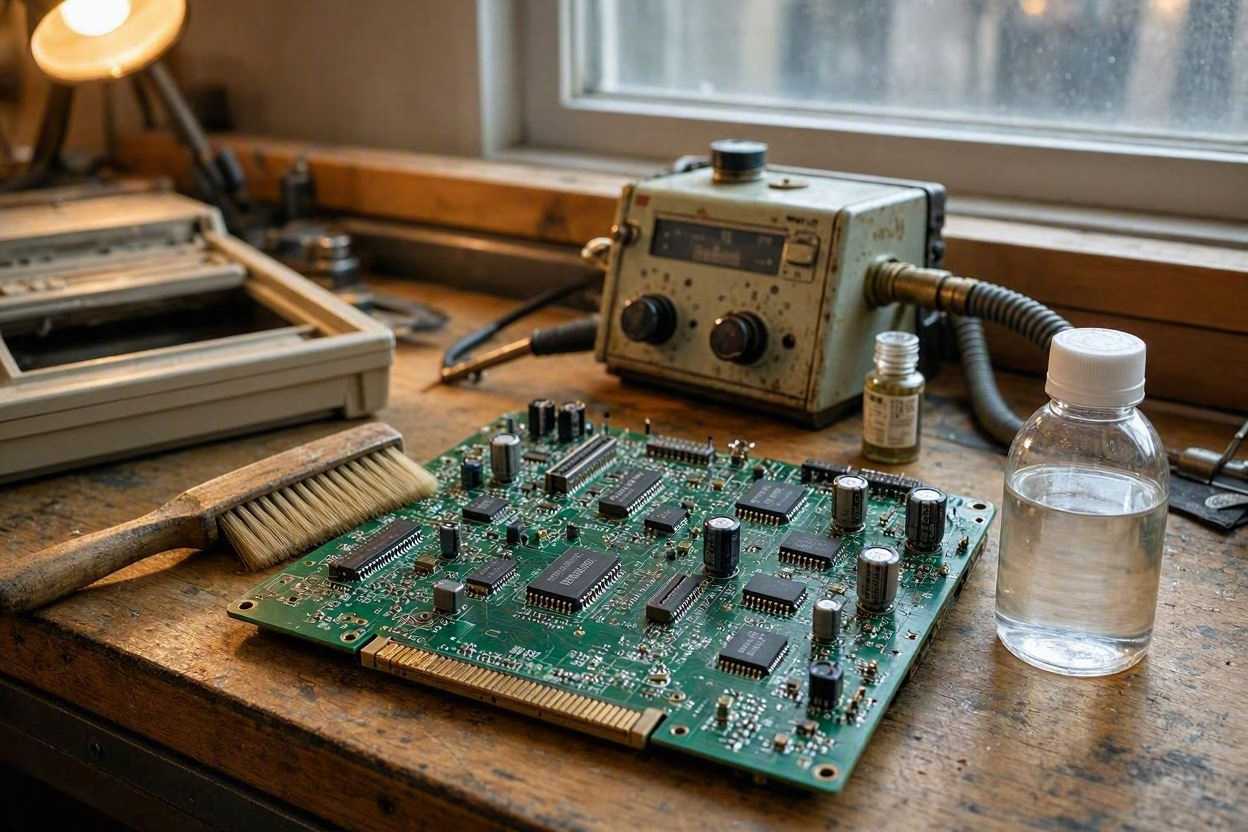
Why not glycerine? Glycerine is hygroscopic and essentially non-volatile. A glycerine film on a PCB never truly dries: it keeps pulling moisture from the air, holds that moisture against traces and contacts, traps dust in a sticky layer, and over time can invite leakage currents and corrosion. These are precisely the failures a board cleaner must avoid. If a thread recommends glycerine on a motherboard, reach for the isopropanol instead - and keep the glycerine for your hands afterwards.
Cases, Plastics, and Rubber: Soap, Water, and Replacement Parts
Neither molecule is a restorer of aged plastics and rubber. Isopropanol is a solvent: it can cloud or craze plastics such as acrylic and polycarbonate, dry out rubber, and soften printed legends, so keep it off case plastics, keycap printing, and drive belts. Glycerine, meanwhile, leaves a tacky, dust-attracting film and offers rubber at best a temporary softening. The honest remedies are unglamorous: wash cases and keycaps - the breadbin shell of a Commodore 64, the chassis of an Amiga 500 - in lukewarm water with a little mild dish soap, and replace petrified floppy-drive belts and cracked feet rather than trying to revive them.
Mechanical Lubrication
Nor is either bottle a lubricant. Glycerine is sticky and hygroscopic, and isopropanol actively strips old lubricant away - useful for cleaning floppy-drive rails and switch mechanisms before re-lubricating, useless as the lubricant itself. For sliding mechanisms use the proper article: a light machine oil, silicone grease, or PTFE-based lubricant, applied sparingly.
A Word of Caution
Isopropanol is highly flammable and should be used with the machine powered off, in a ventilated room, away from sparks and heat; it also dries the skin with repeated contact. Glycerine, by contrast, attracts water - wonderful in a moisturiser, undesirable anywhere near metal contacts. The sensible division of labour is therefore simple: isopropanol on the board, glycerine in the hand cream you apply afterwards.
Glycerine in Cosmetics
Away from the workbench, the same molecule appears in many personal-care products. Glycerine is one of the most common humectants in the cosmetics industry: it draws water into the upper layers of skin and helps keep it supple. You will often find it listed as “Glycerin” or “Glycerol” in:
- Moisturising creams and lotions
- Liquid soaps and shower gels
- Shampoos and conditioners
- Lip balms
- Toothpaste
- After-shave balms
Its popularity among formulators comes from its simplicity: it is inexpensive, generally non-irritating, and compatible with many other ingredients.
Final Thoughts
From Scheele's 18th-century flask to the workbench where someone is carefully lifting decades of grime from an Amiga 500 motherboard, these two humble molecules have proven themselves quietly indispensable - each in its proper place. Isopropanol is the workbench hero: not flashy, but it evaporates cleanly, dissolves forty years of grime, and asks for nothing in return. Glycerine is the bathroom-cabinet hero: safe, inexpensive, and kind to ageing skin.
For anyone restoring a Commodore 64, rescuing an Amiga 500, or simply enjoying the practical side of chemical history, the kit is the same: a bottle of 99% isopropanol for the machine, and a glycerine-rich hand cream for the engineer. Your retro machines - and your hands - will thank you.